• Skip to primary navigation
  • Skip to main content
Squarefoots Facebook Profile Squarefoots LinkedIn Profile Squarefoots Instagram account Squarefoots Google My Business Page

705-735-2246

hello@squarefoot.ca

Squarefoot

Squarefoot

Commercial Real Estate On Purpose

  • Services
    • Acquire
    • List
    • Lease
    • Develop
  • Listings
    • Industrial
    • Multi-Family
    • Office
    • Retail
    • Vacant Land
    • Leasing
    • All Listings
  • Insights
  • About
    • Commercial Real Estate
    • Testimonials
  • Contact
  • Squarefoot Legacy
Show Search
Hide Search

RTOWN Web

March 31, 2021 by RTOWN Web

The City of Barrie, one of the fastest growing cities in Ontario and one that is currently experiencing a huge boom in both residential and commercial real estate, is proposing changes to incentive programs offered through its Community Improvement Program (CIP) to facilitate incentives being given in a more timely manner.

At present, the city does not apply the charges and fees grant and tax increment grant until the Municipal Property Assessment Corporation (MPAC) has reassessed the property after the development (or redevelopment) has occurred. This can take up to two years; if the proposed amendments are accepted, the incentives will be applied when the developer applies for a building permit.

According to Andrew Gameiro, a planner with Barrie’s development services department, this would be a win for everyone involved.

“This approach would improve the administration of the program by eliminating the need to prepare cheque requisitions, particularly for development charge grants, which can be substantial,” said Gameiro.

“Issuing grant payments at the time of a building permit application also assists applicants in covering upfront costs associated with development, thereby making it easier for developers to move forward with construction.

“This is particularly important for large-scale projects in the Urban Growth Centre and the intensification corridors where development is generally encouraged.”

Barrie’s Urban Growth Centre (UGC), as defined by Ontario’s Places to Grow, comprises the downtown core and significant parts of historic Allandale, as well as waterfront and two transit hubs: the Allandale Waterfront GO station and the Barrie Transit terminal.

The UGC will continue to expand and serve as the focal point for the city’s high-density growth — both in terms of people and employment — and intensification in Barrie.

Barrie’s Growth Plans

Barrie has been one of the fastest growing cities in Ontario for decades; to ensure that services and facilities keep pace, the City has created a growth management strategy, which includes intensification in the existing built-up area as well as secondary development areas.

The City has also been developing policies and strategies to facilitate higher-density, mixed-use development in the UGC as well as within important intensification “nodes” — located at significant intersections — and “corridors”, which correspond to highly travelled routes into the downtown area.

Essa Road and Yonge Street, particularly the Yonge Street area which links the Barrie South GO station with the community, have been identified by the City of Barrie as focal points for higher-density development. Other intensification corridors include Bayfield Street, Duckworth Street and Dunlop Street West.

As indicated in The City of Barrie’s 2019 city map below , the built boundary — which consists of delineated built-up areas and undelineated built-up areas — does not extend to the city limits, as they do not take into account the nearly 2,300 hectares of land annexed from the  Town of Innisfil in 2010. Intensification corridors link the city core to these and other areas outside the built boundary.
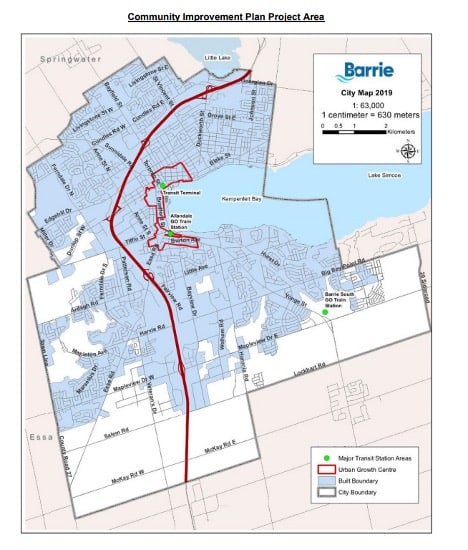
Source: City of Barrie

Barrie’s Community Improvement Program

The City of Barrie currently has three financial incentives through its CIP:

1. Affordable Housing Grant Program;
2. Redevelopment Grant Program; and
3. Heritage Preservation Grant Program.

Each has a different purpose and different eligibility criteria, and each provides different financial incentives, as indicated in the chart below.


Affordable Housing

Redevelopment Grant

Heritage Preservation

Purpose

To encourage purpose-built rental units, affordable housing units or at least 25% affordable units within a larger development

To promote the redevelopment of underutilized sites in the UGC, strategic growth areas and brownfield sites

To support the preservation of buildings on the Municipal Heritage Register

Planning Act Application fee

100% Planning Act application fees

100% Planning Act application fees for the entire project

NA

Building Permit fees

100% fees for affordable units

50% for ground-related commercial, office or institutional components

NA

Development Charges

100% DCs for affordable housing units

50% DCs for ground-related commercial, office or institutional components

NA


25% DCs, to max of $250,000, for affordable units

Tax increment grant for the ground-floor commercial, office or institutional elements, for five years

NA

Tax-increment grant

Tax increment grant for affordable units over five years

Tax-increment grant for developing a brownfield site, up to a $230,000

NA

Other Grant

Per-door grant of $10 per square foot for newly created affordable units, up to a max of $20,000 per unit and a property max of $200,000


50% renovation costs, up to $25,000 per property

CIP section:

Section 9.2

Section 7.2

Section 8.2 of the CIP

To apply for the Affordable Housing incentive program, Gameiro specifies the following as the minimum requirements to include in your application:

  • Cover letter outlining the application and how it meets CIP criteria
  • Confirmation of the proposed housing costs and how they meet the definition of the CIP
  • Floor plans for the proposed building(s), with all rooms labelled and floor areas confirmed
  • Site plan identifying the building location, setbacks and parking
  • Elevation plans of the building
  • The number of affordable units, unit areas and number of bedrooms

Updates underway

After a statutory public meeting in February, city staff are examining input on the updates, which also propose reducing the application intake from three times a year to two, once in the spring and once in the fall. This proposal would reduce the time city staff spend reviewing applications.

In the event that application intake periods are reduced, it could become increasingly important to consider the city’s assessment matrix.

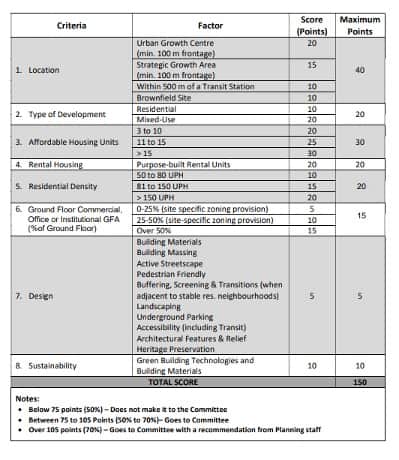
“The City’s CIP includes a scorecard which may be used by the Grant Review Committee to determine which applications meet the eligibility criteria of the CIP,” explained Gameiro.

“The scorecard evaluates redevelopment and affordable housing proposals using criteria that includes (but is not limited to): location, design features, density, mixed-use zoning opportunities, and number of affordable housing or purpose-built rental units.”
Source: City of Barrie

“The maximum score that may be awarded to an application is 150 points,” he continued.

“Applications with a score of 105 points or greater receive a positive recommendation from planning staff; applications scoring between 75 and 105 points receive a neutral recommendation and those with a score of less than 75 points are deemed ineligible for the CIP grant program.

“When submitting an application, applicants must demonstrate how their application advances the goals and objectives of the CIP.”

The first intake for applications runs to May 15, 2021, with city staff examining applications in June.

The Squarefoot Difference

At Squarefoot Commercial Group, we monitor public policy changes, and how they impact our clients and shape our community. Our team has over 55 years of commercial real estate experience, specializing in the Barrie real estate market as well as the greater Simcoe County area.

Squarefoot GIS maps provide clients with valuable insights into specific locations of interest; this comprises a visual of the area and surrounding community, as well as how the intended use would fit into the community and political, economic and social fabric of the area.

We visualize, analyze, and synthesize this data for our clients to assist them in making informed decisions about a site or a land assembly.

Contact us today to discuss your project or commercial real estate needs and how to take advantage of municipal incentives.
Filed Under: Public Policy

March 31, 2021 by RTOWN Web

The downtown Barrie prestige office building has always reflected the best of its day; following its recent updates, it looks forward with confidence.

The five-storey prime office building at 85 Bayfield Street, just north of Collier Street, creates a gateway to Barrie’s city centre, anchoring the western edge of the City of Barrie’s — one of the fastest growing cities in Ontario — commercial financial and professional district.

Constructed in 1981 by KempBay Developments, 85 Bayfield Street offered space for a bank, a legal clinic and other professional offices. In 2003, Jamie Massie, President & CEO of Georgian International, moved the company’s headquarters into the prestigious 500 suite. 

“I look out to the most beautiful view – frozen Kempenfelt Bay, the CKVR (broadcast) tower,” said Massie. “It’s been really motivational for me to look out and be stimulated. It’s spectacular.”

Shortly after Georgian International moved in, Massie got to work on giving the building a new, modern look in line with the company’s values and priorities. Inside the building, “we’ve renovated every square foot, including the lobby,” explained Massie. 

They also added new front and rear lobbies and updated the stairwells. Outside the building, Massie created a setting to showcase the prime office space and to address some challenges tenants faced. 

The Challenges

When it was constructed, the downtown commercial building was located up the street from Steele’s China Shop, owned by one of the original KempBay principals, Harris Steele. Between the china shop and the commercial property were some low rise buildings that housed businesses including an optician’s studio and a financial planner, as well as a take-out Italian restaurant. 

There was little room for parking and the commercial property turned inward. The 1980s design, with access limited to interior building entry, disconnected it from the neighbourhood.   

“It was very much out of the late 1980s; simple architecture and precast concrete, simple curtain walls. It was very typical of its time,” said Salter Pilon Architecture’s Ryan Stitt. 

“There was a disconnect from allowing visitors to access the building correctly,” Stitt explained, “and there was an uninviting message with a legal clinic on the ground floor”.  

Another challenge was flow — how people moved around and used the space. The 1980s design made it feel cold, explained Stitt, and changes were needed to improve not only the look but the feel and flow of the space, inside and out.

The Solutions

To modernize and improve the space, Massie worked with his tenants to bring the commercial office space from the 1980s into the 2020s. Some changes were cosmetic, while others focused on function. 

Thought was given to how people use the building, whether they are employees or visitors, as well as their enjoyment of the space. It included how light flows as well as how people use the building’s common areas — not just their office — and the area around the building.  

Addressing those needs required more space outside, to provide convenient parking as well as larger and brighter lobbies. 

Commercial property for sale on both Bayfield and Worsely streets were acquired to provide space for the building and for parking. A second-level employee lot was constructed on Worsely along with a dedicated entrance. Inside the building, upgrades focused on creating collaborative workspaces.

A café that is filled with light in the warmer months, provides a more informal but collaborative space with clients as well as a space to relax and link with the community friends over lunch. 

Light fills the café when the days are longer and provides a space for office professionals to recharge and meet others in the building and friends from the community. The Common Good has a sophisticated urban vibe. 

“I love it. I eat there every day,” said Massie, adding that a restaurant was part of the plan to better serve the firms that have chosen the building, as well as their employees. 

The café can be accessed by a door that opens from beside the patio, with a southern view, or an interior door from the main building lobby. 

Just beyond the café’s three-season patio, there’s ample room to park, which draws in people coming to the downtown core by car. There’s well-kept green space that extends to the corner of Collier and Bayfield streets, further enhancing the connection with the downtown core and community. 

“We wanted our building to reflect us as a company, a community-driven business in the downtown core,” said Massie. “It’s a good, vibrant space.”

The Results

Inside and out, the prestige commercial office building demonstrates thoughtful care for everyone who enters the building, as well as quality workmanship, style and stability.

“Jamie is about quality. He’s not just about making it functional. He wanted a good design, form and quality,” said Stitt. “Workmanship is important.”

Massie added he wanted to build on the KempBay Developments’ legacy of helping build downtown Barrie as a good place for business. Given its proximity to Toronto, Barrie’s industrial real estate market is growing by leaps and bounds, with recent insights suggesting it is mimicking trends in the GTA.

Comparatively affordable commercial property for sale in the downtown makes it a popular choice for investors, but it’s important to choose a commercial realtor who knows the area and has extensive knowledge of local market conditions. 

Squarefoot Commercial Group, CCIM-educated commercial realtors with more than 55 years of commercial real estate experience, provides the highest level of commercial real estate expertise and experience in the Simcoe County Region. Contact us today!

Filed Under: Transformations

March 24, 2021 by RTOWN Web

Whether it’s the supply of vaccines or PPE or baking supplies and paper towels, COVID-19 has highlighted the weak links in our supply chains, which are often global or at least international. Indeed, the pandemic could be a catalyst for a complete rethink of what we manufacture and how we get it to market. Naturally, that would have a big impact on real estate markets, especially commercial real estate in Canada.

Early in the pandemic, grocery stores struggled to keep the shelves stocked with the basics we took for granted – from paper towels and toilet paper to flour and eggs. Shutdowns in production reduced the selection of canned soft drinks. Hand sanitizer demand prompted some breweries and distilleries to switch to manufacturing hand sanitizer, which could be packaged in plastic bottles, rather than the increasingly scarce aluminium cans. Today, the Canadian government awaits the delivery of internationally-produced COVID-19 vaccines.

Supply Challenges Highlighted by the Pandemic

Businesses need to connect their goods with consumers, be they other businesses who use these goods as inputs, or customers who use the goods themselves. 

Now more than ever, it’s time to consider your supply chain – how you will acquire your inputs – as well as where you will manufacture your goods and how you will get them to your customers in a time and cost-efficient way. Gas prices, tariffs and highway congestion all add to costs. Rest assured, you’re not alone in this.

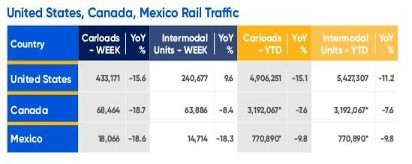
Companies large and small are rethinking how they will deliver products in a reliable and cost-effective manner. Globalization continues to be under scrutiny, and trade volumes are down markedly, as reflected in port and railroad data. As all of these phenomena collide, COVID-19 could be the catalyst for a complete rethink of supply chains as we know them.

Caption: This chart shows the decline in the transportation of goods in Canada, the United States and Mexico. 

While there has not been a complete breakdown in supply chains, the disruptions seen across a myriad of industries and regions have sparked a conversation into whether globalization, and the premise behind global trade flows, need to be rethought. 

Any reconfiguration of existing supply chains would have a significant impact on North American industrial real estate markets. While the point-of-origin for many imported goods could shift, for example from Asia to Latin America, Eastern Europe or Africa, an equally seismic shift would be for manufacturing to be done on home soil. Returning manufacturing to North America could yield several benefits, including being closer to the end consumer, less risk in the transport of goods, and greater oversight and safety protocols.

Supply chain patterns would look very different if goods were produced domestically than if imported from another part of the world. It should be noted, however, that if these changes occur, it would be over a period of years — if not decades — and would vary considerably by industry. For example, auto production is a very complex and highly specialized process, so it is doubtful that it would be altered in any meaningful way. Apparel, on the other hand, could be more easily shifted to another country or, indeed, produced domestically.

Domestic Production Could Be the Solution

Governments are seeing the value of returning manufacturing to a domestic location. Canada has been relying on European production facilities for both Pfizer and Moderna vaccines, which have been delayed partially due to production limitations but which also have been affected by trade rules. 

On Feb. 2, Prime Minister Justin Trudeau announced a tentative deal with U.S. vaccine-manufacturer Novavax to produce in Canada, at a new Montreal facility capable of making two million doses/month, a small percentage of the 52-million dose contract. Other domestic facilities are also coming online, notably University of Saskatchewan in 2022 and Precision NanoSystems in Vancouver in 2023.

For Canada, Ontario’s Greater Golden Horseshoe is the centre of economic activity and prosperity. The region generates 25 per cent of Canada’s GDP (source here). It is close to the American market and is home to an educated workforce. 

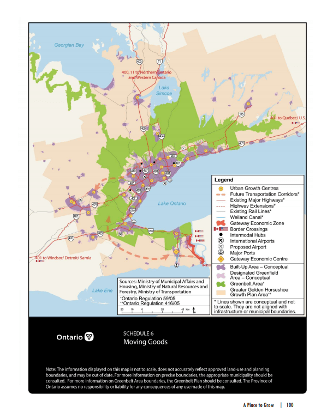
As the only urban growth centre north of the GTA, Barrie is the hub of the Simcoe region economy and one of the fastest growing cities in Canada. Smaller centres support the urban centre, which has easy Highway 400 access to the GTA as well as northbound out of Ontario, as the accompanying map from Ontario’s growth plan shows. An airport with 24/7 customs service is a short drive out of town and there is also a small regional railway that serves industrial areas in Essa, Innisfil and Barrie. 

Barrie real estate is clearly a good option to consider for investors and businesses looking to lease commercial property, with its many transportation and economic links. The area’s growing workforce is young and educated, which has only been increasing in recent years as young professionals flee Toronto to settle in Barrie, which offers more value for money in residential real estate. 

As SIOR and CCIM specialists, we at Squarefoot Commercial Group can help you find the best location for you to grow your business. Specializing in commercial real estate in the Simcoe County region, we have the experience and market expertise to help you achieve your short- and long-term goals. Contact Squarefoot today!

Filed Under: How To of Real Estate

March 24, 2021 by RTOWN Web

To help Canadians cope with the pandemic-induced recession, the Bank of Canada will continue to keep interest rates low – which is good news for not just residential mortgage buyers, but investors looking to borrow to buy commercial real estate. 

In fact, interest rates are so low, they are negative real rates, economist Ben Rabidoux said in a Jan. 21 BDAR webinar. A negative real interest rate occurs when the interest rate is lower than the inflation rate. 

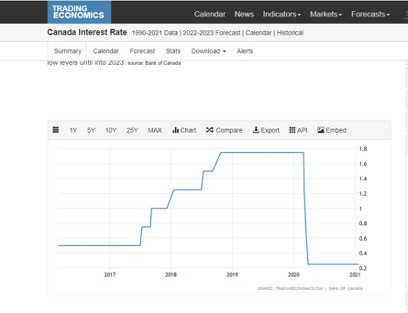
The Bank of Canada’s overnight rate is 0.25 per cent and the Bank Rate at 0.5 per cent, the Bank of Canada announced Jan. 20. The next scheduled date for announcing the overnight rate target is March 10. 

The Bank of Canada is aiming to keep rates low, possibly until 2023. Its tactic is to buy up three to five-year bonds, which affect the most common mortgage, the 5-year fixed, he explained. 

Caption: In this graphic from the BDAR webinar, Rabidoux illustrates the Bank of Canada’s bond holdings by maturity date.

In the residential real estate market, this means that homeowners are opting to renegotiate. They are choosing to refinance to reduce their higher-cost debts like credit cards and instead increase their mortgage, which is at a much lower rate. 

Credit card balances and other unsecured loan balances are down 12 per cent year over year, Rabidoux noted.

“Consumers are paying off higher-interest debt and swapping it for very low-interest mortgage debt. It’s very good for the consumer,” Rabidoux said. Video at 17:20

However, as property values rise, their net worth increases, which offsets the higher mortgage balance. They may also choose to invest in their real assets. 

This chart shows the 5-year mortgage rate trend – and why renegotiations are occurring.

Caption: Source: https://tradingeconomics.com/canada/interest-rate

The Bank of Canada notes that it will continue to provide monetary policy support, as the pandemic continues to dampen spending and employment, particularly among the lowest-income quartile. 

“Canada’s economy had strong momentum through to late 2020, but the resurgence of cases and the reintroduction of lockdown measures are a serious setback. Growth in the first quarter of 2021 is now expected to be negative. Assuming restrictions are lifted later in the first quarter, the Bank expects a strong second-quarter rebound,” it said in a Jan. 20 news release, available here.  

The Bank of Canada noted real GDP declined 5.5 per cent last year, but the bank projects a 4 per cent growth this year, 5 per cent in 2022 and 2.5 per cent in 2023.

The Consumer Price Index inflation is about one per cent, and it is forecast to rise to about 2 per cent over the first six months of 2021, the bank projects, and stabilize there until 2023, when it could reach 2.5 per cent.

“The (bank) will hold the policy interest rate at the effective lower bound until economic slack is absorbed so that the 2 per cent inflation target is sustainably achieved. In our projection, this does not happen until into 2023,” the bank said in a Jan. 20 news release.

“To reinforce this commitment and keep interest rates low across the yield curve, the Bank will continue its QE (quarantine easing) program until the recovery is well underway.” 

The bank added it will continue to purchase bonds. “We remain committed to providing the appropriate degree of monetary policy stimulus to support the recovery and achieve the inflation objective,” it said. 

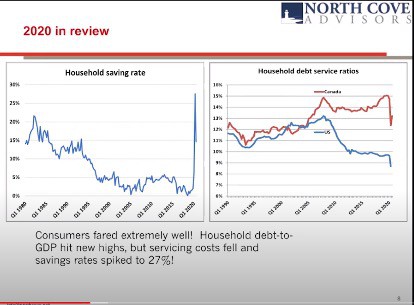
Rabidoux said the Bank of Canada strives to contain inflation by increasing the money supply, which is at a 40-year high. As well, household savings are relatively high.  If sitting still in a savings account, money doesn’t create inflation, Rabidoux explained. However, later this year, as spending rises, inflation could begin to rise.

Caption: This slide from the BDAR webinar shows household savings contrasted with household debt servicing ratios, which are down due to lower interest rates and refinancing.

“After every pandemic, historically, there’s been a period of consumer spending,” the economist noted, adding there’s $90 billion in savings accounts in Canada.

For higher income households, there’s a propensity to invest – including in real estate. Now may be your time to consider investing in commercial real estate, especially as the market heats up. With our knowledge of the Barrie region, Squarefoot can help you find the best commercial properties for sale in Barrie. Our team of commercial realtors has more than 55 years of experience and vast knowledge of the Simcoe County markets. Find out what our clients say about us. 

Call us at 705-735-2246 to find your dream commercial property listing!

Filed Under: Public Policy

March 17, 2021 by RTOWN Web

Dave Morrison, president of Toronto-based financing company Morrison Financial, looks up at one of downtown Barrie’s most challenging office buildings, but he doesn’t get discouraged. Instead, he gets to work.

He sees opportunity where others have failed; opportunity for businesses to flourish, opportunity for the community to use the building in its efforts to revitalize and rebrand its city core. 

The story of the building at the corner of Collier and Mulcaster streets, now named the Lakeview Corporate Centre, is filled with years of financial struggle, $11 million in trades liens and a syndicated mortgage funding failure. After the original builder, Mady Developments, went bankrupt and Fortress Real Developments — which subsequently acquired control — defaulted on its loan, Morrison Financial acquired the property as a mortgagee-in-possession. 

Challenge and Opportunity

As mortgagee-in-possession, Dave Morrison found himself with a challenge, and opportunity, in the only provincially designated urban growth centre north of the GTA. Although he could have converted it to residential, he opted to finish the adjoining Lakeview Condos and keep the commercial space for lease. After all, with a condo building filled with people just next door, there was a ready-made market for commercial tenants. 

Bank of Montreal (BMO) and the Canadian National Institute for the Blind already occupy about half of the building, and with new tenant Jimmy Chews, Morrisons intends to make the commercial centre a destination for foodies — and that’s the base he’s building as he looks to sign leases the pandemic put on hold. 

Substantial Demand for a Downtown Supermarket

To attract a grocer to the centre, Morrison conducted an online survey; receiving 1,400 responses, this survey confirmed there is substantial demand for a grocer in the area.

“More than 10 percent of the immediate catchment area responded,” said Morrison, noting that a geographic area is defined as the 12,000 people who live within walking distance or a short drive. He added that the area on the east side of downtown is projected to grow to 24,000 people by 2028.

“The government is really bent on doubling the population in the downtown,” he explained. “When office workers, City Hall and other employees nearby return to the office after the pandemic, they’re going to need a nearby grocery store.” 

In addition to the people living and working downtown, students are another important demographic to take into consideration. “There is no major metropolis in North America that doesn’t have a substantial post-secondary presence in its downtown core,” said Morrison, adding that the Georgian College northeast end campus is closeby, and the Helen and Arch Brown School of Design and Visual Arts is just a few blocks away.

The City of Barrie acknowledged from the very beginning that a grocery store was needed on that spot. In fact, the call for proposals included a clause that a grocery store be included in any mixed-use project on the site. Find out more about public policy in Simcoe County.

Planning for community needs after the pandemic

In the midst of Mady Development’s financial struggles, Sobeys, which was to occupy about 25 percent of the building, pulled out of the project. The grocery area was designated on the second level of the three-storey commercial base, which also was to include 90 public parking spaces.

“We’re very confident about the location,” he continued, adding that it was a unique opportunity for grocers looking for commercial space for lease. “The online survey we conducted  is basically a customer list for a new grocer.” 

Morrison is rethinking how shoppers will access the grocery store. To better link it with the street and those who walk to the store, he’s considering putting an escalator entrance in what is now one of the commercial units on either Collier or Mulcaster street. 

Morrison looks up at the building, but he also looks beyond it. He’d like to see those who invest in the city core as well as those in the Lakeview Corporate Centre succeed.

Whether people live nearby, work downtown or go to school downtown, they all need one thing: food. And that’s what he’s selling now, as he imagines a full-service grocery store with freshly prepared food and wine to take home after a day of learning or working in downtown Barrie. If you’d like to find out more about opportunities for commercial real estate in Barrie, or to view commercial property listings, contact the team at Squarefoot to discuss opportunities to grow your business or portfolio.

Filed Under: Transformations

March 17, 2021 by RTOWN Web

What is a Tenant Representation Agreement? 

Tenant Representation is when a real estate Agent represents the interests of a Tenant in their search for a commercial property for lease. Along with the agency disclosure form, most companies use an exclusive representation letter to show Agents and Landlords of properties that, indeed, the Agent represents the Tenant, how the Tenant’s Agent will be compensated and the duration of the Agency contract.  

Why should I care?

As Agents, we are all aware of the law requiring real estate professionals to disclose to Tenants and Landlords, who the real estate broker and their Agent is representing in a transaction. We also make you familiar with the agency disclosure forms which will have a place to check, indicating whether an Agent of a broker is representing the interests of the Landlord, the Tenant, or both. Both parties sign this form, and this makes it clear to all parties, who is representing who in a transaction. 

To this end you will be presented with your options, a contract for services, and asked to choose the type of representation your situation requires, as well as to sign the contract to begin the process.

If this is not your experience, it should be as it is mandated by our Code of Ethics for all Realtors.

What if I don’t sign?

The Code of Ethics clearly states that loyalty ultimately rests with the client and that a broker or salesperson must protect and promote the client’s best interests. However, the Code also requires that a broker or salesperson deal fairly, honestly and with integrity and provide conscientious service to all clients and customers. 

You can decide to be a customer, rather than a client, but should be aware that the obligations of the brokerage will differ and we will not owe you a fiduciary duty. Customer status also means that we may help you prepare the paperwork for an offer, but you are on your own when gathering market intelligence, context of value compared to other properties and deciding upon your offer strategy. 

Should you decide to become our Client, we will assist you to prepare and negotiate an offer seeking the most advantageous terms on your behalf (including price), provide referrals to other professionals, and help you do your due diligence on a specific property. As our Client we shall maintain our fiduciary duty that requires that we always act in your best interest. 

Multiple representation

Multiple representation means that a brokerage is representing both the Landlord and Tenant in a transaction. There are no standard terms of services under Multiple Representation so you need to refer to your representation agreement before any offer is submitted. Multiple representation must be consented to in writing. 

When such a situation arises, ask questions, and make sure you are comfortable with how it may affect the services provided to you. 

At Squarefoot, we often work in Multiple Representation. We explain what you should tell us and what you should keep to yourself which allows the contract negotiations to work out the finer points of each party’s interests.

How are Tenant Representatives Compensated?

It is stated clearly in the Tenant Representative Agreement letter that the Landlords of the property compensate the Agent in the manner consistent with that market. The Tenant Representative or “Tenant Rep” broker splits the leasing or sales commission with the owner’s Listing Agent. A flat fee or hourly consulting rate can also be a form of compensation. A one size fits all solution does not exist, nor should it, and there is no such thing as a standard fee in commercial real estate – it is what both parties feel is fair.  

The fee is paid to the Listing Agent (who represents the best interest of the Landlord, NOT the Tenant) regardless of whether the Tenant uses their own Tenant Rep Agent. The Tenant generally does not pay a direct fee in a transaction. There are exceptions to the compensation and who pays, and therefore it is important to establish a firm understanding and communicate this understanding in writing as soon as possible.

Holdover clause

While there is no “standard” holdover clause, generally, a holdover clause means that if a property, that we have introduced to you, is bought or sold or leased within “X” days of the Tenant Representation Agreement expiry, and you have contracted directly with the Landlord without our assistance, commission may still be payable to our firm. The general principle is that we have introduced you to the property, provided you with market information, analysis, and context, sufficient to make an educated and informed decision and therefore we should be compensated for our work.

Why Use a Tenant Representative? 

Tenant Reps become an integral part of the Client’s relocation/location team with the others; a space planner/architect, real estate lawyer and other specialists as needed, e.g., phone, furniture, computers, attorneys, accountants, contractors, movers, telephones, and cabling, etc. 

As the Tenant Representative, we lead the process. We first analyze your situation, your short- and long-term goals, and we listen to your concerns. As Tenant Reps we provide market analysis and guide you through the process, along with the various team members, to accomplish the goal whether it be a lease renewal, relocation, or build-to-suit. 

We consider it a privilege to assist companies in getting from point A to point B. A strong level of trust and relationship is formed — as well as many great memories! At Squarefoot, we often receive new assignments and reciprocal referrals as a result of a job well done. Find out what our clients are saying about us.

It is in the Tenant’s best interest to retain a Broker who specializes in Tenant Representation, specifically: 

  • One who knows the specific market conditions inside and out.  
  • One who can locate a suitable location based upon the client’s parameters.  
  • One who understands the language that should and SHOULD NOT be in a lease contract.
  • One who understands the multiple cost exposures written into the language of a lease contract.

When you do engage with a Tenant Representative, you can be assured of saving valuable time and money and getting the peace of mind that comes with it. In essence, as your Tenant Representative, we become an advocate for you, and a “right arm” to the decision maker.

Before you sign

As brokers we want to provide you with the best service we can. To make the most of this relationship, it’s important to clarify your needs and expectations. To avoid misunderstandings later on, it’s important not to make any assumptions. Take the time to ask what we expect from you and what your obligations are to the process.

Discuss all of the services that will be provided. Take the time to clarify the fees and costs related to these services and make sure the written agreement is clear.

Leasing Services 

Whether it be office, retail or industrial space that you require, Squarefoot can assist you in finding the best commercial space for lease under the most favorable leasing terms. Let us start today by compiling a survey of commercial property for lease that best suits your requirements. 

We will:

  • Identify commercial property for lease.
  • Negotiate commercial lease terms. 
  • Provide full leasing services to ensure a smooth transaction. 

Contact us at 705-735-2246 for details!

Filed Under: How To of Real Estate

  • « Go to Previous Page
  • Page 1
  • Page 2
  • Page 3
  • Page 4
  • Go to Next Page »

Squarefoot Commercial Group

Squarefoots Facebook Profile Squarefoots LinkedIn Profile Squarefoots Instagram account Squarefoots Google My Business Page

© 2026 Squarefoot Commercial Group
Sutton Group Incentive Realty Inc., Brokerage - Independently Owned and Operated
All Rights Reserved.
Privacy Policy

Connect with us

241 Minets Point Road,
Barrie, Ontario
L4N 4C4

705-735-2246

hello@squarefoot.ca

Get Updates

Sign up to stay informed about development plans and policies in Simcoe and Barrie.

Email:

We use a marketing automation platform in order to manage our client relationship and send you commercial electronic messages. By clicking to "Subscribe", you acknowledge that the information you provide will be transferred to us in accordance to our Privacy Policy and Terms of Use.

CONNECT WITH US

Every good real estate transaction has a circle of Trusted Advisors working diligently behind the scenes.

Your lawyer(s), your accountant(s), your engineer(s), your planner(s), your architect(s), your lender(s) and YOUR REALTOR(S).

This field is for validation purposes and should be left unchanged.
Your Name(Required)