
• Skip to primary navigation
  • Skip to main content
Squarefoots Facebook Profile Squarefoots LinkedIn Profile Squarefoots Instagram account Squarefoots Google My Business Page

705-735-2246

hello@squarefoot.ca

Squarefoot

Squarefoot

Commercial Real Estate On Purpose

  • Services
    • Acquire
    • List
    • Lease
    • Develop
  • Listings
    • Industrial
    • Multi-Family
    • Office
    • Retail
    • Vacant Land
    • Leasing
    • All Listings
  • Insights
  • About
    • Commercial Real Estate
    • Testimonials
  • Contact
  • Squarefoot Legacy
Show Search
Hide Search

RTOWN Web

June 1, 2022 by RTOWN Web

Photo of Downtown Barrie Ontario at night

Municipalities can manage their growth and development through careful land-use planning while addressing social, economic, and environmental concerns. The responsibility for long-term planning in Ontario is shared between the province and municipalities.

In truth, these governments don’t always work together to direct land-use planning. Learn about the land use planning process and how it’s affecting Simcoe County’s development.

Situation

The land-use planning process balances the interests of individual property owners with the wider needs and objectives of the community. 

Decisions about land use affect almost every aspect of life in Ontario; this means land use planning directly impacts the quality of a community. Here’s how it works:

  1. The province sets out the legislative framework and policies through the Planning Act and a Provincial Policy Statement (PPS). 
  2. Municipalities and planning boards implement the province’s land use planning policy framework.  Although municipalities have some flexibility when planning their community objectives, they must ensure their land use plans and decisions are “consistent with” the PPS. 
  3. When conflict arises, approval authorities and the Ontario Land Tribunal (OLT- formally LPAT) provide dispute resolution mechanisms for the protection of provincial interests as well as the interests of individual landowners.

It’s important to remember that land-use planning is fundamentally a public process and considers the input of developers, residents, indigenous communities, and individuals.

Significance

While the land use planning system makes sense in theory, the reality is different. In our experience, especially in  Simcoe County where development is substantial, the province fails to appreciate the culture of life outside of the GTA. The result is years of “planning by numbers” for a lifestyle nobody wants. 

Affordable housing has become the victim of poor policy mandates and bureaucratic red tape that delays new development. Even flawed policies take time to take effect—and time works in favour of scarcity and against choice and affordability. 

Scarcity drives inflation, further accelerating the existing inventory price (or pushing it into overdrive, as we’ve seen in recent years). As a result, homeownership has become beyond the reach of many middle-class Canadians. 

Results

After four years of extensive public engagement and consultation, the City of Barrie’s new Official Plan was adopted by City Council on February 14, 2022. 

We’re pleased to see the City of Barrie is showing a commitment to key themes like connectivity, environmental sustainability and housing diversification. 

The problem we see with the plans for Simcoe County development is that only a portion of them will result in shovels in the ground. The other plans are ‘value add’ players that de-risk property, define density and add a premium for time and work completed before reselling the land to an actual developer. 

Don’t get us wrong, there is room in the market for some of these ‘value add’ players, but while we play musical chairs with our land inventory, choice goes down. The inventory does not increase, but prices do. 

Unless efforts are made to improve and accelerate development opportunities in Simcoe County, which starts with the land use planning process, “affordable housing” will remain just another political buzzword and true housing affordability will remain beyond reach for our children and generations to come.

Who We Are

Squarefoot Commercial Group specializes in commercial and industrial real estate. We focus on sales and leasing, repurposing and repositioning commercial real estate assets in Barrie, Simcoe County and its surrounding communities. View current sale and leasing opportunities at Squarefoot.

With over 60 years of commercial real estate experience, our team has a granular understanding of local markets; while our focus is local, our designations, memberships and associations are global. Meet Our Team. 

Squarefoot is actively involved in selecting the best intensification sites in the Simcoe County area, and we work collaboratively with local governments, other realtors and advisors to uncover development potential in Simcoe County as well as some of the fastest-growing communities in Ontario. Ready to experience the Squarefoot advantage? Contact us today!

Filed Under: Intensification & Land Development

May 27, 2022 by RTOWN Web

photo of miniature buildings

A chronic national housing shortage is exacerbating Canada’s affordability crisis, particularly in Ontario, with home prices surging to record highs seemingly overnight. 

The Government of Ontario has announced several legislative and regulatory changes to make homeownership more attainable for Ontario residents. These changes include three key amendments to the Non-Resident Speculation Tax (NRST) that will make buying property in Ontario more costly to foreign entities.

Ontario’s Non-Resident Speculation Tax (NRST)

The Non-Resident Speculation Tax (NRST) is a tax on the purchase or acquisition of an interest in residential property by individuals who are not citizens or permanent residents of Canada or by foreign corporations/entities or taxable trustees.

The NRST applies to the transfer of “designed land,” which is land that contains at least one but no more than six single-family residences, including:

  • detached and semi-detached homes; 
  • duplexes and triplexes;
  • townhouses and condominium units. 

It does not apply to other types of land, including:

  • land containing multi-residential rental apartment buildings (more than six units); 
  • commercial land and industrial land;
  • agricultural land.

Additionally, it doesn’t matter whether a single-family resides on the property or if the owner occupies the property – if the property was designed as a residence for a family, it’s taxable. This means now could be a great time to start looking at investment opportunities in commercial land and industrial property in Ontario. 

Key Changes to the Non-Resident Speculation Tax (NRST)

Effective March 30th, 2022, the following amendments will take effect:

  1. The NRST rate will be increased from 15 percent to 20 percent of the purchase price in addition to the general Land Transfer Tax (LTT) in Ontario. 
  2. The NRST will be expanded from the Greater Golden Horseshoe (GGH), the urban region centred around the City of Toronto, to all regions across Ontario. 
  3. Rebates for certain foreign students and foreign workers in Ontario under the previous NRST structure will be eliminated for any agreements signed on or after March 30th, 2022. 

Note: The Non-Resident Speculation Tax (NRST) is not applicable to purchase agreements outside of the Greater Golden Horseshoe Region (GGH) that were signed on or before March 29th, 2022. 

Who has to pay the Non-Resident Speculation Tax (NRST)?

The Non-Resident Speculation Tax (NRST) applies to individuals who are not Canadian citizens or permanent residents of Canada or by foreign corporations or taxable trustees. Foreign nationals in the Ontario Immigrant Nominee Program, protected persons (refugees), spouses of Canadian citizens and permanent residents of Canada will continue to be exempt from the NRST.

IMPORTANT❗ The NRST applies if any one of the transferees is a foreign entity or taxable trustee, regardless of their share of ownership. This means that if a transfer of residential property is made to four transferees, only one of which is a foreign entity, the NRST will apply to 100 percent of the value of the property.

If it sounds complicated, it’s because it can be. Make sure you’re dealing with an experienced and trustworthy Commercial Realtor so you can avoid any unpleasant and costly surprises on closing day. 

The Squarefoot Difference

Buying property in Ontario has never been more complicated or more challenging. An experienced Commercial Realtor with knowledge of local markets and the community, a strong network and reputation is an indispensable tool for both Buyer and Seller in one of the world’s hottest real estate markets.

Squarefoot Commercial Realtors have been committed to serving, developing and creating opportunities in the Greater Golden Horseshoe Region for more than 40 years. We are known for our infallible knowledge of the market, negotiation skills and integrity, and we can prepare you for the reality of purchasing a commercial property in Ontario today. Ready to invest in commercial real estate in Ontario? Contact Squarefoot Commercial Group today.

Filed Under: Commercial Real Estate, Intensification & Land Development

February 17, 2022 by RTOWN Web

Your Realtors for Location-Based Analytics

You don’t need to be in the business of real estate to know that location can make or break an investment. From industrial site selection, retail success probability, to purpose-built rental housing, location and timing, must be a deciding factor.

In our data-driven world, industry sectors and individuals are increasingly turning to data-backed analysis to make faster and better-informed business decisions, while quantifying risk and constraints through due diligence.

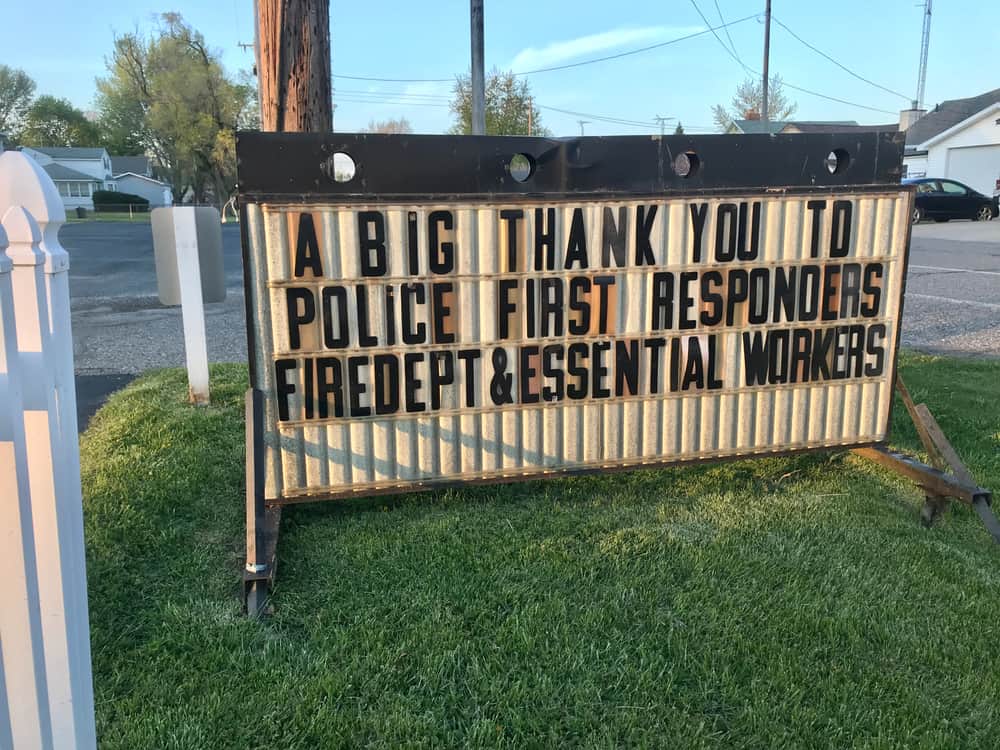
big sign saying thank you to police, fire department and essential workers

Situation

Data is everywhere—but it’s useless without analysis. You may have a mountain of data but, unless you know how to evaluate and apply that data in context, it won’t help you. In order to find the best location for real estate investment, you need contextualized and properly analyzed data..

In the hands of the inexperienced, a superabundance of data can muddy the waters, making it harder to get a clear picture of a location and the people in it.

During location analysis, an experienced commercial Realtor considers a number of data points to ensure they are pertinent, they will normalize the data so you are getting an apples-to-apples comparison, and will provide you with the context you need to understand the merits of a location.

Significance

Whether you’re using location analysis for commercial property for your business, income property, or land for development, you need the expertise of a local agent with insights into good investment property opportunities in your target area, including unlisted and soon-to-be-listed commercial properties.

You need relevant data sets and someone to analyze these data sets to quantify the success or failure of a specific location. This will allow you to make the best decision for you and your goals for the property.

Relevant data sets, combined with local knowledge and expertise will provide you with the expert context to make an informed decision quickly.

Solution

Squarefoot’s proprietary data sets, in combination with our real estate location analysis tools, allow our team to effectively target, vet, and compare specific locations in order to achieve your investment/business location goals. Using void analysis, we can even help you identify goods and services gaps in a target area so you can find the most competitive and beneficial area to grow your business. 

the words community and police shaped as puzzle pieces linked by a bridge the gap puzzle peice

Result

Using data sets and location analytics, Squarefoot helps you identify opportunities others will have overlooked. We help you identify the ideal property for your specific goals, and effectively negotiate a price you’ll be happy with in order to close the deal.

View current commercial property listings in Barrie and surrounding areas.

About Squarefoot Commercial Real Estate

After more than 60 years in commercial real estate in Barrie and the Simcoe County region,  Squarefoot has the knowledge, experience and community relationships to help you locate properties that align with your investment strategy and business needs.

We provide clients with the knowledge they need to realize their vision. This could include providing insight on policy changes that could impact your projects and what will encourage, discourage or limit the potential opportunity.

We know what is trending and ending in our markets early, and as a result, we help our clients make the best decisions with an understanding of demand, timing, land value, and the highest and best use. 

Contact Squarefoot Commercial Group today.

Filed Under: Development Proposals, Transformations

August 13, 2021 by RTOWN Web

Squarefoot Commercial Group has been actively involved in the community for many years. (Volunteering and giving back provides a level of fulfillment that commercial real estate can’t always provide.)

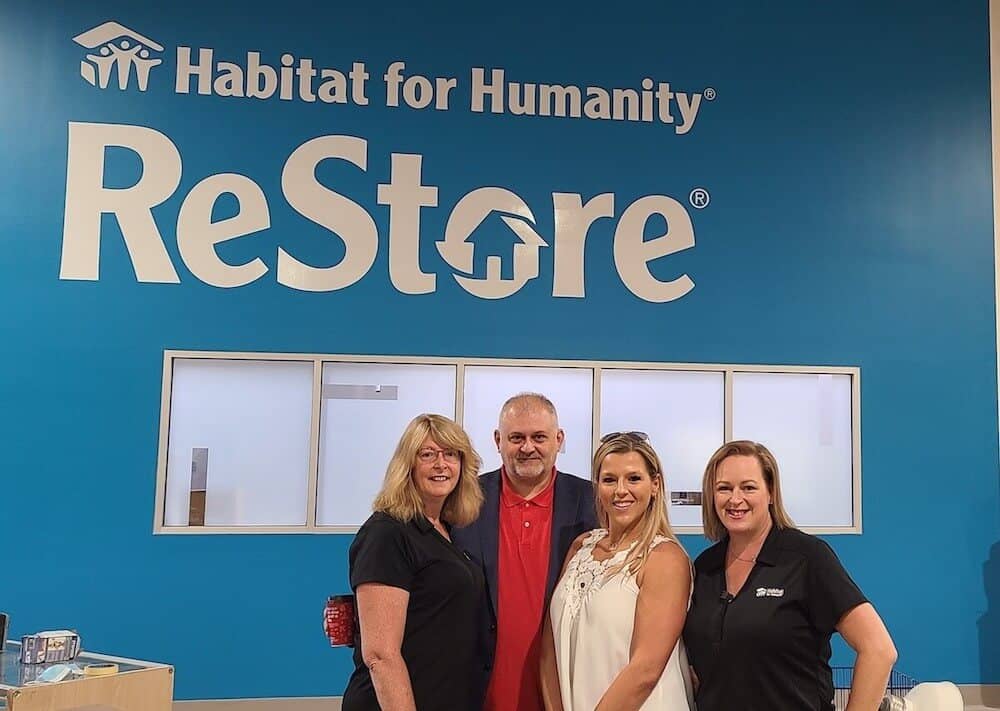
In 2003, Squarefoot Broker Linda Loftus (CCIM SIOR CIPS MRICS FEA), worked with the Habitat for Humanity (Habitat) Board of Directors to help secure their long-time home at 128 Brock Street, a small industrial building in central Barrie that housed the Habitat ReStore and the affiliate offices. 

In 2011, Habitat reached out again when they needed an Alliston location; Shannon MacIntyre (CCIM SIOR, Broker) was quick to help them open a second ReStore, start accepting donations, and making sales.

Squarefoot Commercial Group continues to work with the organization, in both a volunteer and broker capacity. Through her condo board, Broker Ashley Polischuik (B.COMM(HONS) CCIM) met the current Habitat CEO. After presenting creative solutions for future land purchases for Habitat family builds (in an increasingly unaffordable market), she joined the LAND Committee and the Board of Directors as Treasurer. She continues to sit in these roles.

After 20 years at Brock Street, this donation-reliant organization decided that the costs of maintaining a rapidly aging building were too great. They decided to go from owners to tenants, which will allow them to carry on the important mission of building homes for deserving families. 

From Owners To Tenants

After the decision came figuring out the logistics of the move.

In 2017, the City of Barrie zoning bylaws changed; as a result, although their Retail / Building Supply use at Brock Street (now an industrial zone) had been grandfathered, a relocation meant that the new ReStore would need to be in a commercial zone. Options that both met their requirements and were within their budget were limited. 

The Barrie Examiner building had been vacant for several years following the cancellation of the Post Media publication. The large production and distribution facility located in the north end of Barrie was now for sale.

Although it was previously an industrial building, both due to its original use as a Beaver Lumber store and then as the newspaper facility, the rezoning in 2017 ended up changing the building to a Commercial Zone to match with the neighbourhood.

However, in order for Habitat to hold a tenant position in a building that was for sale, a local buyer willing to take on the role of landlord needed to be located to add the building to their portfolio and accept Habitat as their tenant. 

With the local buyer in tow, the plan began to roll out in January 2020. Conversations with the person in charge of real estate at Post Media had provided a roadmap to a creative solution for Habitat’s next steps, as they also needed to unload the asset off the books as part of a new corporate mandate.

A sale agreement was reached between the newly found buyer and Post Media for the Bayfield building, as well as a long-term lease agreement between Habitat and the purchaser. Habitat’s Brock Street building quickly sold off-market to a Squarefoot client; gains made from the sale are planned to be put towards leaseholds at a new store, as well as future builds. 

As a result of delays caused by the COVID-19 pandemic, as well as the different transitions each party needed to make following the closing of the sales, both Post Media and Habitat needed to finalize short-term leasebacks in their respective buildings to facilitate seamless transitions. Although delayed, the sales of both closed in Q3 2020, with leases beginning immediately afterward. 

Habitat secured the perfect location, with the right zoning and within their budget, on a 10-year commitment, setting the stage for a successful and bright future. 

A Bright Future

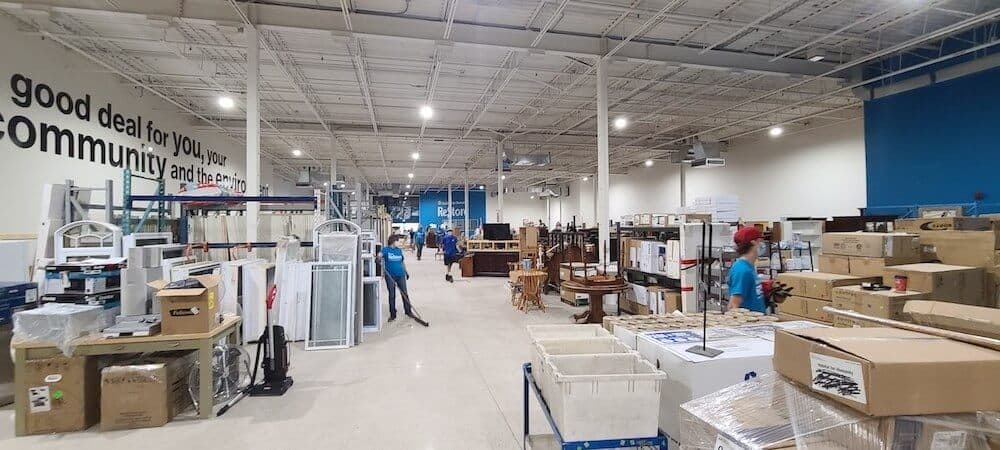
Several years ago, Habitat set its mind on building homes for dozens of families per year, not just one or two. This relocation will increase ReStore sales by over 25%, if not more. The costs to maintain an organized, purpose-built store are lower and the location, in terms of exposure and access, is top-notch.

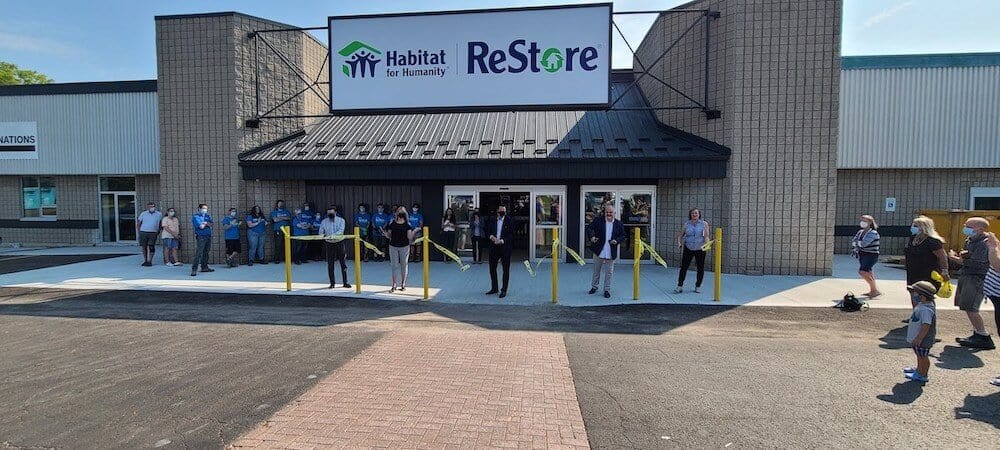
On July 13th, 2021, Habitat for Humanity Huronia ReStore opened for business and the lineup of customers to get in the building was overwhelming. 

Community building with Habitat has been part of Squarefoot’s journey from the first time Linda found ReStore their first location on Brock Street, to when Shannon found them a second location in Alliston and again when Ashley found the Bayfield Street location. Three generations of Squarefoot brokers have been proud to help carry forward Habitat’s mission for almost two decades.

Squarefoot Commercial Group will continue to be a partner with Habitat for years to come. We will also be available to help answer questions and offer whatever service is needed by this strong, proud organization that helps our community in so many ways.

CEO of Habitat for Humanity Huronia, Robert Cikoja explains: “Squarefoot is a real community partner. They are the model of leadership, guidance, expertise, and integrity. They excel in both professionalism and philanthropy. Their presence and support in the community through volunteering and charity involvement builds a strong community which we all benefit from.”

Filed Under: Development Proposals, Transformations

July 21, 2021 by RTOWN Web

Land development generally goes through a customary purchase process that consists of:

  1. A conditional period during which deposit money is risked and is therefore forfeitable
  2. Closing

The negotiation of condition(s) is as important as price. Buyers want as much time as they can to close with as little money at risk as possible, but sellers want the opposite. The agreed-upon terms depend on the state of the market, advice given and received by the sellers and their trusted advisors.

In slow markets, favourable terms of purchase and sale are more likely. With fewer buyers, sellers are typically more willing to give a potential purchaser more time to investigate the property without requiring larger deposits. In a hot market, sellers are less afraid of losing  a deal and are more concerned about tying up their property when another buyer, and possibly a better offer, could be just around the corner.  As conditions in the marketplace shift toward seller-dictated terms (requiring cash offers without financing contingencies, short due diligence periods and high prices), the market would indicate that it is nearing its apex, so the beginning developer who is having trouble competing with other buyers may just be better off waiting.


If the site consists of multiple land parcels under separate ownership (often referred to as land assemblies), progress is further complicated by the fact that all the necessary parcels must first be acquired with similar terms and conditions and closing dates. Neighbours often talk with each other and are aware of what prices have been offered to others in the assembly. These factors and others make land assembly acquisition a particularly complex business that requires sophisticated negotiation and acquisition techniques to ensure that the owner of the last or other key parcels does not insist on an exorbitant price. Knowledgeable brokers who have completed land assemblies know how to manage the expectations of sellers, as well as get the most reasonable terms for a buyer, with closings that are successful for the sellers.


The terms of acquisition set the stage for all that is to follow. An overpriced or complicated ownership structure of the lands can doom an otherwise well-conceived project. When buying land, developers are looking to confirm that:

  • they can build what they want;
  • they have time to study all site conditions affecting feasibility; 
  • market data for sales of a similar product supports their business case;  
  • they can obtain financing; and 
  • they will be able to assess project economics in a business plan before the required closing date.

Sites with special problems — such as easements, conservation issues, compensation costs, natural heritage designations or contamination —should be approached with caution, as the land may prove to be more difficult and cost-prohibitive to develop.

Inexperienced developers may be thinly capitalized, meaning the level of their debt is much greater than their equity capital, leaving little room for unanticipated costs or delays. Before deciding to tackle problem sites, new developers must determine whether the problems associated with the site can be solved within a reasonable time frame and within budget. If they cannot answer that question affirmatively with a high level of confidence, they should probably look for another site.


Even before submitting an Agreement of Purchase and Sale (APS) contract, buyers may discuss or submit a non-binding Letter of Intent (LOI) or term sheet to sellers that sets out the business terms for purchase of the property. 

The Letter of Intent specifies:

  1. the property to be purchased; 
  2. its price; 
  3. payment terms; 
  4. Timing; 
  5. release provisions (for transfer of lien-free sub land parcels, in the case of seller financing, to the buyer); and,
  6. other major business points.

Letters of Intent are especially helpful when the buyer or seller plans to use a long, specially-written legal purchase and sale agreement rather than a standardized OREA Brokers form. The LOI saves time and unnecessary legal expense in the beginning because it clarifies the primary aspects of the transaction. If the buyer and seller cannot come to agreement on the primary business terms, there is no point in exchanging full legal documents. The LOI is non-binding, but it does call for signatures by both parties to signify agreement on the major transaction points. 

The offer to purchase must clearly indicate all contingencies or penalties other than specific performance (compelling the parties to consummate the agreed-upon deal) for failure to close. The Agreement of Purchase and Sale (APS) typically includes:

  1. physical inspections; 
  2. environmental assessments; 
  3. regulatory approvals; 
  4. title checks; and/or
  5. financing approval.  

Buyers cannot assume that they can negotiate more contingencies/conditions or other issues in the APS than what was agreed upon  in the original LOI. The APS cannot be more restrictive than the LOI to purchase unless both parties agree to the changes. 

Three items make the offer to purchase binding: 

  1. specific consideration (deposits) – enough to entice the seller to take the property off the market for a given period; 
  2. proper identification of the property; and 
  3. a time to close or to enter into the purchase and sale agreement.

It’s important to remember that purchase and sale agreements are a subject with vast implications. There is no one-size-fits-all APS. 

Agreements of Purchase and Sale will be further discussed in  subsequent blog articles.

Filed Under: Intensification & Land Development

May 18, 2021 by RTOWN Web

What Is Going On?

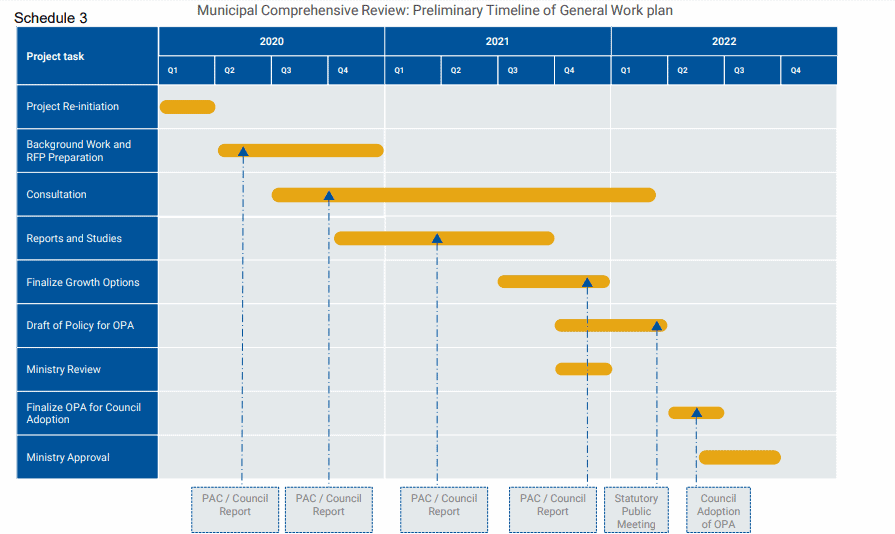
The County is undertaking a Municipal Comprehensive Review (MCR) in accordance with the Provincial Growth Plan, A Place to Grow: Growth plan for the Greater Golden Horseshoe (Office Consolidation 2020), as mandated by the Provincial Government.

What Is An MCR?

The MCR is a specific planning process used to bring an Official Plan (OP) into conformity with the Growth Plan. The intent of an MCR is to establish the ov​erall pattern of development and environmental management in the County. The MCR is the foundation for more detailed local planning.

Who Is Affected?

The MCR will apply to the 16 Local Area Municipalities in the County, and excludes the Cities of Barrie and Orillia, both of which are separated Cities.

What Is Involved?

Numerous policy matters are impacted by the MCR and will result in updates to the County OP. Growth management is impacted, because the County is required by the Province to plan for a population of 555,000 and 198,000 jobs by 2051 vs. the 2041 population projections which were less. The Land Needs Assessment is key to determining how much growth can be accommodated in the existing settlement areas and whether additional land is needed.

The MCR will also review, report, and recommend on Provincial policies and plans on the following matters:

  • refinements to the provincial natural heritage system;
  • refinements to the provincial agricultural land base;
  • growth management;
  • employment;
  • climate change; and
  • watershed management.

Who Is In Charge?

Hemson Consulting has been awarded the contract to lead the stakeholders through the process.

To date, Hemson as the lead consultant, has put together a multi-disciplinary team of professionals to address the various components of the MCR as follows:

  1. Provincial Natural Heritage System Review and Refinement – North South Environmental Inc.
  2. Provincial Agricultural System Review and Refinement – DBH Soil Services Inc.
  3. Employment Strategy – Hemson Consulting and Cushman Wakefield
  4. Climate Change Strategy – Hemson Consulting and Laura Taylor Designs
  5. Watershed Management Strategy – Wood Environmental & Infrastructure Solutions Inc.
  6. Growth Management – Hemson Consulting
  7. County Official Plan Amendment(s) – Meridian Planning
  8. Communications Strategy – The Planning Partnership, Meridian Planning, and Nbisiing Consulting

What Work Will Be Undertaken?

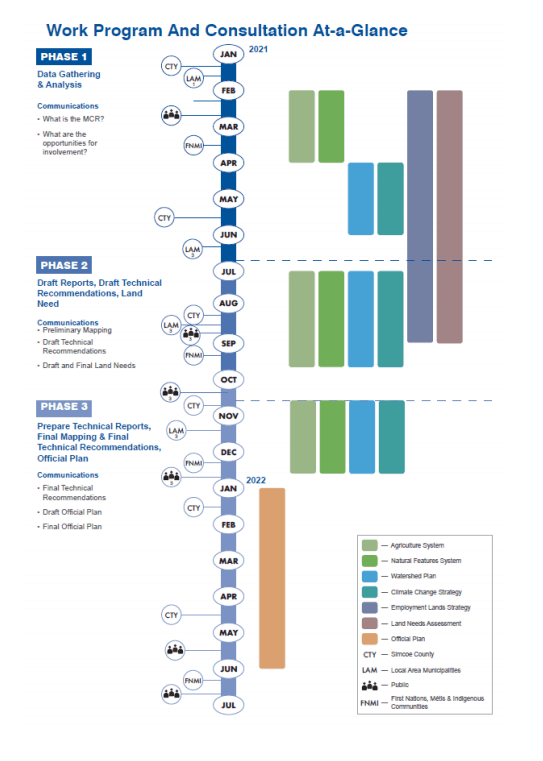
The work includes various technical studies. The work for each of the technical studies will be done in three phases. Phase 1 includes the review of existing information, including mapping. Phase 2 includes refinements to mapping and preparing draft recommendations. Phase 3 includes the preparation of the topic specific technical reports that will include final recommendations and mapping. The technical studies will be prepared in collaboration with the local area municipalities, the public and stakeholders.​

Source: https://www.simcoe.ca/dpt/pln/mcr

When The Work Is Done, Then What?

The MCR will be implemented through a County Official Plan Amendment or Amendments, with each having to be approved by the Ministry of Municipal Affairs and Housing, after first being adopted by County Council. 

How Will The Work Be Implemented?

The MCR will be completed by working collaboratively with County staff. Engagement during the MCR process will ensure that the Province, Local Area Municipalities, Indigenous communities, County Council, Conservation Authorities, the general public, and other stakeholders are informed of ongoing work and technical reports and material as it becomes available.  Stakeholders will be involved throughout the MCR to understand and review the mapping and recommendations from the various technical inputs.

Source: https://www.simcoe.ca/dpt/pln/mcr

When Will The MCR Be Complete?

July 2022.

AFFORDABILITY VS. DELAY = INFLATION.

Has affordability become an oxymoron in the Province of Ontario?

Your thoughts?

Squarefoot Commercial Group, a specialized commercial real estate group, helping companies assess how much space is required. Contact us for more information.If you’re looking for a commercial real estate agent in Barrie, we’ve got you covered. Don’t believe us? Read our client testimonials.

Filed Under: Public Policy

  • « Go to Previous Page
  • Page 1
  • Page 2
  • Page 3
  • Page 4
  • Go to Next Page »

Squarefoot Commercial Group

Squarefoots Facebook Profile Squarefoots LinkedIn Profile Squarefoots Instagram account Squarefoots Google My Business Page

© 2026 Squarefoot Commercial Group
Sutton Group Incentive Realty Inc., Brokerage - Independently Owned and Operated
All Rights Reserved.
Privacy Policy

Connect with us

241 Minets Point Road,
Barrie, Ontario
L4N 4C4

705-735-2246

hello@squarefoot.ca

Get Updates

Sign up to stay informed about development plans and policies in Simcoe and Barrie.

Email:

We use a marketing automation platform in order to manage our client relationship and send you commercial electronic messages. By clicking to "Subscribe", you acknowledge that the information you provide will be transferred to us in accordance to our Privacy Policy and Terms of Use.

CONNECT WITH US

Every good real estate transaction has a circle of Trusted Advisors working diligently behind the scenes.

Your lawyer(s), your accountant(s), your engineer(s), your planner(s), your architect(s), your lender(s) and YOUR REALTOR(S).

This field is for validation purposes and should be left unchanged.
Your Name(Required)