• Skip to primary navigation
  • Skip to main content
Squarefoots Facebook Profile Squarefoots LinkedIn Profile Squarefoots Instagram account Squarefoots Google My Business Page

705-735-2246

hello@squarefoot.ca

Squarefoot

Squarefoot

Commercial Real Estate On Purpose

  • Services
    • Acquire
    • List
    • Lease
    • Develop
  • Listings
    • Industrial
    • Multi-Family
    • Office
    • Retail
    • Vacant Land
    • Leasing
    • All Listings
  • Insights
  • About
    • Commercial Real Estate
    • Testimonials
  • Contact
  • Squarefoot Legacy
Show Search
Hide Search

RTOWN Web

March 10, 2021 by RTOWN Web

Ontario’s More Homes, More Choices Act could mean more opportunities for developers to help build more holistically healthy communities. 

When the Act became law in June 2019, it introduced not only changes to Ontario’s Planning Act, but also revised the Development Charges Act. 

To take advantage of this new system — which requires municipalities to approve projects in more compressed timelines and which gives them more flexibility in asking developers for cash or community benefits — we strongly advise that do your homework before the municipality asks for it. Be prepared. 

Expected to meet tighter timelines, municipalities could be more demanding in determining whether an application is complete. It’s best for you to have your studies finished as you hand in your proposal. Similarly, a time-saving and strategic approach would be to have an appraisal in hand before you begin to discuss community benefits.

Key points

Looking back, under the Development Charges Act, 1997, the scope of services was limited to hard services – notably water, wastewater and stormwater management, along with roads – and there was a 10% discount applied on the capital cost of soft services like library and recreational programs.  

In addition to the changes to the More Homes, More Choices Act, there is also Bill 197, the COVID-19 Economic Recovery Act, which passed in July, 2020, as well as Ontario Regulation 509/20 Community Benefits and Parkland, which came into effect on Sept. 18, 2020.

So what does all this mean? In an eblast to its members, the Municipal Finance Officers’ Association (MFOA) highlighted these changes: 

  • The maximum Community Benefit Charge = 4% of land value for a residential development 
  • Municipalities must prepare annual reports re. the accounts for the Community Benefits Charges Account and the parkland dedication account
  • Some developments are exempt: long-term care homes, retirement homes, universities and colleges and non-profit housing 
  • Eligible services under the Development Charges Act are no longer subject to the 10% mandatory discount
  • Municipalities can update their DC bylaws to recover 100% of the eligible costs

For Toronto’s chief planner Gregg Lintern, it’s about community. “We’re not changing just for the sake of making more money, but changing the investment in communities and making people’s lives better,” he said. “That takes leadership.”

It’s About Community

Burlington’s director of city building Heather MacDonald agreed the new approach is about community. “Burlington was very successful at using Section 37 of the Planning Act to build affordable housing,” she told a BILD webinar. 

Section 37, titled An Essential Tool for Building Healthier Neighbourhoods, empowered municipalities to allow height and/or density increases in exchange for community benefits, such as preserving heritage resources, providing community space in the development or agreeing to providing a certain number of units at affordable prices. Some municipalities used that effectively.

“We’re very concerned that the tool is not available in the same way now. We were just embarking on an affordable housing strategy,” MacDonald added. 

Barrie has used the existing tool as it intensifies and adds housing to the only Urban Growth Centre north of the GTA – downtown Barrie. Barrie’s General Manager of Infrastructure and Growth Andrea Miller highlighted a project that boosts the affordable housing supply, while intensifying Barrie real estate in the core and helping the city achieve the higher density Ontario now requires in the outer ring. 

“Help us to be innovative,” she told the BILD webinar late last year.

The first in the city, The 5 Points consists of 203 residential condominium units as well as ground-floor commercial, located on the northwest corner of the city’s iconic intersection not far from the lake. 

As well as nine affordable units, the community benefits include a 1,000-square-foot public square and $10,000 in furnishings.

Caption: At left: The Residences at Five Points, available at fivepointsbarrie.ca.

Surge in Developments

Likely by design, the city has since seen a surge in developments that include affordable housing, as the community has a low 3.2-per cent vacancy rate, according to the CMHC. 

Another plan just north on Bayfield Street blends market and affordable housing in 108 units. It has yet to receive city approval. 

Brampton’s Commissioner of Planning and Development Richard Forward said the updated community benefits could support developers and builders who consider the needs of the community they’re building, while the municipalities work to increase transparency and build more well-rounded neighbourhoods.

“At the end of the day, I want a culture of caring,” he said – and that’s a two-way street, a relationship between the municipality and those who are building it.

Municipal legal specialists, Dentons, noted the new community benefits regime removes any incentive for municipalities to “under-zone” areas, so they can then collect height and density bonuses. Instead, the new law replaces that much-criticized approach with an incentive to update zoning bylaws. Read more from Dentons. 

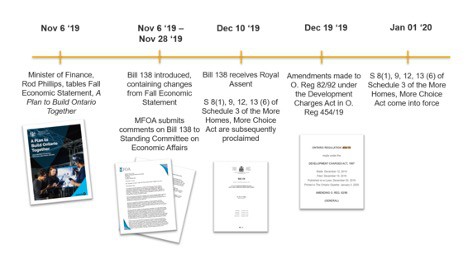
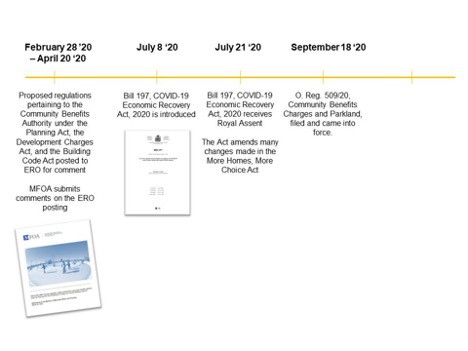
Timeline
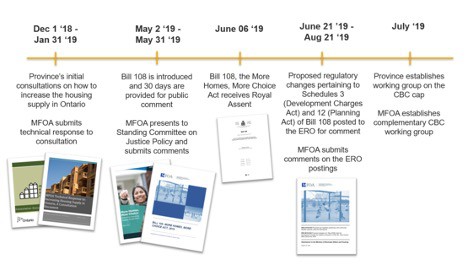
Source: Municipal Finance Officers’ Association (MFOA) Hub for Bill 108

Takeaways

Even in the most-cordial relationships, disagreements can occur. That’s why you should have your property appraisal in hand. With that, the discussions about community benefits begin with a serve, so to speak, from your side of the court. 

In instances in which the developer and municipality disagree on the amount of the charge, Davies Howe outlines the timeline and procedure. The firm notes the landowner or developer can begin by providing an appraisal of the site being developed. A dispute resolution process requires a third appraisal if the developer’s and the municipality’s appraisals differ more than five per cent. Click here for more details.

For more information and updates about these policy changes, visit our Public Policy page. You can also check out the Municipal Finance Officers’ Association’s YouTube video series or read the eblast and provincial submissions, available here. For more information about the Barrie housing market, including Barrie real estate opportunities and commercial property listings, contact Squarefoot today.

Filed Under: Public Policy

March 10, 2021 by RTOWN Web

Millennials are looking for a quality of life at work and at home – and the pandemic has been driving them out of Toronto into suburban markets like Barrie. 

“This will be the best year in housing for 50 years,” economist Ben Rabidoux told BDAR members in a Jan. 21 webinar — and it’s the smaller and mid-sized markets, such as the Barrie real estate market, that are driving this growth. 

“The smaller secondary markets are driving the price increase,” he said, adding that Barrie real estate prices rose 23 per cent over the past year.  The vibrant housing market in Canada is no longer depending on Toronto and Vancouver, but on the suburban markets that offer families value for money.

Caption: Economist Ben Rabidoux detailed how suburban markets are driving up house prices in this slide from the BDAR webinar on Jan. 21.

As a result, it’s very unlikely governments will move to dampen activity as it did several years ago when Toronto and Vancouver markets drove up prices. 

“They’re not going to bring in a new stress test,” he said. “The government is going to let this burn hot for a while, which is a perfect set up as we head into the spring.

“Spring 2021 may be the hottest housing market since the late 1980s.”

In addition, the Bank of Canada intends to hold interest rates low, as detailed in its Jan. 20 overnight rate announcement; click here for more details.  

Rates are projected to remain below one per cent, which enables mortgages to be renegotiated or bought at very affordable prices. 

As families work from home, they are saving on the costs of commuting in terms of both time and money. Hours spent on the highway lengthen an already long workday, a sharp contrast to working from home, not to mention the costs of vehicle maintenance, wear and tear and fuel. 

Pros and Cons of Working from Home

That said, conducting Zoom meetings in the dining room while managing the kids and their schooling, then getting reports done when the kids are asleep, is not a sustainable lifestyle. The office offers a separation of home and work, and a child-free environment that can be productive and collaborative. 

“I don’t believe offices are dead,” asserted Rabidoux. 

While employees have been productive through the pandemic, it is more challenging for them to be connected, and a Cushman and Wakefield study, The Future of Workplace, noted that personal connection is an “extremely important component of employee experience”. 

Face-to-face meetings not only boost mental wellbeing for the workers, but for well-being for the team and the sense of connectedness to the company.  People will return to the workplace, with new appreciation and new demands, the study highlights, available here. 

Another study, by The Harris Poll in the spring of 2020, highlighted the office as a “critical place” for meaningful connections. More information is available here. 

Some key takeaways about the shift to working from home include: 

The benefits:

  • 62 per cent said they saved money by not commuting
  • 58 per cent said they enjoyed a more relaxed dress code
  • 55 per cent enjoyed not having to commute
  • 52 per cent reported a better work-life balance

The challenges:

  • 35 per cent struggled with separating work and home life
  • 33 per cent struggled with concentrating on work
  • 31 per cent cited uncontrollable noises as frustrating
  • 27 per cent struggled with collaborating virtually
  • 25 per cent cited a lack of private, quiet space

More details available here. 

The Future of Work Spaces

Companies, therefore, may wish to provide smaller collaborative spaces where staff can get away from home but conveniently, so employees can enjoy not commuting and a better work-life balance while being productive and connected with the company.

A solution would be a small office, a flexible and connected space that’s shared, where people can file their work-related documents and resources, where they can plug in and zoom professionally with others on their team and stay connected to the company in a more intimate office setting. The satellite site would feature resources like a state-of-the-art photocopier/scanner, a server, and a small kitchen, where staff can connect with others based in the same community as they take a coffee break. 

Satellite offices that link people physically and virtually in these smaller markets offer employees the best opportunities, as many are no longer interested in three hours on the highway each day, but who anticipate a return to a professional office setting.

With the only urban growth centre north of the GTA, commercial real estate in Barrie is becoming an increasingly popular choice for investors. The City of Barrie also enjoys a vibrant residential real estate market, so it’s a perfect location that offers value for you as well as your employees.

Squarefoot Commercial Group, a specialized commercial real estate group, helps companies assess how much space is required and how flexible it needs to be: do your staff, for example, each need an office or can an office be shared? Contact us for more information.If you’re looking for a commercial real estate agent in Barrie, we’ve got you covered. Don’t believe us? Read our client testimonials.

Filed Under: How To of Real Estate

March 5, 2020 by RTOWN Web

What Market Factors are at Play and How are They Affecting Barrie Industrial Real Estate?

Is Barrie’s Industrial Real Estate Market mimicking trends in the GTA? It sure seems that way. According to the Toronto Real Estate Board’s (TREB) Commercial Realty Report, the fourth quarter of 2019 shot average square foot prices for industrial leases up to $9.62/sq.ft. In comparison, the average rate in Q4 of 2018 was $7.62. 

It’s no secret that the GTA is constantly expanding. And as more people and businesses populate the area, demand for industrial real estate edges prices higher at a rapid rate. The same is happening in Barrie – not so far from the GTA. Barrie’s office real estate vacancy rates are low, and rental rates are climbing. This will no doubt trickle into Class B rental rates as well as the supply of Class A properties dwindle. 

Sellers and Landlords Profiting the Most

I’m sure we can all recall the 2008 recession and the havoc it caused for landlords. Rental rates dove by 35% and it took nearly 10 years to bounce back. In 2007, rates per sq.ft went up to $6.50/square foot, and by 2008 had gone down to $4.50/sq.ft. Now, industrial real estate rental rates in Barrie have surpassed $6.50/ square foot and are projected to hit $9.00/ square foot over the next 5 years for smaller rental spaces. All these factors combined make it an excellent market for Landlords and Sellers. 

Expert Advice in finding Commercial Real Estate ‘Gems’

Reduced availability of real estate properties, land parcels currently locked up in the Salem Secondary Plan for Urban Design & Sustainability, coupled with properties not coming to market has put higher pressure on land prices, existing real estate building spaces and per-square-foot rental rates. However, at Squarefoot, we specialize in finding the best investment opportunities for our clients, and that includes affordable land in and around Barrie. If you’re thinking of purchasing industrial development property in Barrie or you have a property to sell, give us a call and we will be happy to help you find exactly what you’re looking for. 

“So What?!?”

If you are looking to find a property for your business, call us now. The list of shovel ready lands is very small. Recognize the phrase ‘shovel ready’. Although it may appear that there are tracts of land sitting idle, there is generally a reason – not serviced, no cost-sharing agreement in place, etc.

When we find you what you are looking for, be prepared to act. Procrastination only results in a lost opportunity, an accelerating price model and inertia for your business.” – Linda Loftus, Broker

Filed Under: Commercial Real Estate Tagged With: Barrie industrial real estate, Barrie real estate, commercial real estate, Commercial real estate Simcoe County

February 25, 2020 by RTOWN Web

The Office of the Procurement Ombudsman (OPO) is organizing an event this March to increase diversity among bidders on federal government contracts. This one day summit was created in order to raise awareness for private and public sector programs that seek to enrich the lives of people from diverse groups such as:

  • Indigenous people and groups
  • Racialized people
  • People living with a disability
  • All gender identities
  • Minority groups

Diversifying the Federal Supply Chain – Key Event Details


Now in its second year, this event will provide the opportunity to take part in workshops and listen to speakers discuss important and timely topics. The day will include:

  • Presentations from Government of Canada representatives, along with private sector organizations
  • Information booths and kiosks
  • Dedicated workshops to help suppliers hone the practical skills necessary to win federal government contracts
  • Keynote speaker, The Honourable Anita Anand, Minister of Public Services and Procurement


Participating Organizations

  • The Canadian Aboriginal and Minority Supplier Council
  • Canadian Council for Aboriginal Business
  • Canadian LGBT+ Chamber of Commerce
  • The Inclusive Workplace and Supply Council of Canada
  • Industrial Research Assistance Program (National Research Council) which includes:
    • The Office of Small and Medium Enterprises
    • Office of the Procurement Ombudsman
    • Procurement Strategy for Aboriginal Business
    • Trade Commissioner Service
  • Women in Business Enterprises Canada

Event Date, Time & Location

The Diversifying the Federal Supply Chain Summit will take place on:

Wednesday, March 4, 2020
Time: 8:15 a.m. – 4:00 p.m.
Admission: Free
Location: The Carlu, 444 Yonge St. Toronto, ON M5B 2H4

*Please be advised, this is a scent-free event

Registration

Registration for this free event will fill up fast. To reserve your spot, follow this link and fill out the registration form: http://opo-boa.gc.ca/sommet-summit-eng.html

Filed Under: Public Policy

February 25, 2020 by RTOWN Web

Our Level 10 Clients can quickly understand commercial real estate market opportunities and capitalize on them. Maps and spatial analysis supplement their experience and intuition with powerful decision-making insight. Decision making information that our Level 10 Clients can take to the bank.

Commercial Property Site Analytics 

Our Level 10 Client has requested that we help him to find another successful location.

Mixed-use development has proved very profitable. By combining commercial and residential uses, this property has become a winner in his portfolio. Our Level 10 Client understands the characteristics that have made the previous site successful and wants to find other locations to replicate this successful formula.

How Squarefoot.ca finds new areas of opportunity 

We Help Clients Find the Commercial Real Estate that Best Suits their Needs.

Once we quantify the key factors behind the current development’s success, we look for areas to find those same characteristics elsewhere. 

1. Custom, in-depth data

We overlay zoning data to focus the search on areas that are approved for mixed-use development, then apply our custom-made layers with a series of demographics filters to zero in on likely candidate sites.

2. Three sites share winning characteristics

Now our Level 10 Client and his investors can evaluate the financial feasibility of three sites that share the characteristics they are looking for. Which site offers the best return on capital with minimum development barriers?

3. The team identifies the best site for new development

With the data examined and financial models complete, our Level 10 Client knows with certainty that this site best matches his budget, the financial risk profile, and the successful mixed-use development profile.

“I had the pleasure of working with Linda on a couple of transactions with two of our large corporate clients: Aviva Canada Inc. and Investors Group Financial Services Inc.  I was extremely impressed with Linda’s knowledge of the market, attention to detail, and great analytical skills (she holds a CCIM designation). Her negotiation skills are second to none.  She has an in-depth understanding of our corporate clients’ needs and objectives.  She always gets the best results. I recommend Linda to all my C&W colleagues who have client requirements in Barrie and the surrounding area.”

ALINA SZPIR
Senior Director, Global Occupier Services Canada
Cushman & Wakefield

Filed Under: Transformations

February 25, 2020 by RTOWN Web

Last year, the Municipal Property Assessment Corporation (MPAC), assessed 5,360,528 properties across Ontario and found that commercial, residential, and new construction real estate in Ontario reached an estimated value of $2.96 trillion dollars. This assessment roll was conducted in municipalities across Ontario, and broken down further to illustrate the strong growth across all types of properties:

New Construction, Commercial Real Estate Properties, and Residential Additions
  • 4,833,059 Residential properties were assessed and valued at a total of $2,125.53 Billion
  • 222,043 Farms and Agricultural properties were valued at $139.09 Billion
  • 161,956 Commercial properties were valued at $319.83 Billion
  • 79,358 Industrial properties valued at $114.91 Billion
  • 47,317 Special or Exempt properties were valued at $144.92 Billion
  • 16,795 Multi-residential properties were valued at $119.17 Billion

New Construction, Commercial Real Estate Properties, and Residential Additions

Reflected in MPAC’s latest property assessment roll in Ontario is the construction of 2,000 new commercial real estate buildings and more than 44,000 residential property builds over 2019. The construction of these new properties, along with additions being built onto existing properties throughout 2019 totalled an estimated $37 billion dollars. 

Nicole McNeill, MPAC’s President and CAO said, “Ontario continues to grow. In 2019, MPAC added value to municipal assessment rolls from new construction and/or additions to existing properties worth more than $37 billion,”

How MPAC Determines Property Value

Every 4 years, MPAC updates the assessment of all properties across Ontario, both commercial and residential. The next assessment, taking place this year, will be based on what property values were as of January 1st, 2019. In November of 2019, over 800,000 notices were delivered to property owners, showing any changes to their assessed property value over the past year. 

MPAC determines property values based on sales data from Ontario’s land registration system, Teranet. Looking at sales in a particular area can be a good indicator of assessed property value for your own residence. Property taxes are similarly assessed using sales data and the value of your home. 

Upgrading your home, such as adding an addition can increase the value of your home and therefore, increase the amount of property taxes you pay. However, this doesn’t happen all at once. For instance, if you decide to upgrade your home between two assessment periods, such as between 2020 and 2024, the Ontario government will ‘phase in’ the value of your home changes to reflect your taxes instead of being hit with tremendously higher taxes at once. 

2020 Forecast

According to some new reports, Ontario will lead the way in 2020 for construction growth, especially in the GTA. Toronto’s office building explosion, along with transportation development projects and a housing market that continues to bounce back, construction is forecasted to grow by another 6-7 percent this year, looking very optimistic.

Filed Under: Intensification & Land Development

  • « Go to Previous Page
  • Page 1
  • Page 2
  • Page 3
  • Page 4

Squarefoot Commercial Group

Squarefoots Facebook Profile Squarefoots LinkedIn Profile Squarefoots Instagram account Squarefoots Google My Business Page

© 2026 Squarefoot Commercial Group
Sutton Group Incentive Realty Inc., Brokerage - Independently Owned and Operated
All Rights Reserved.
Privacy Policy

Connect with us

241 Minets Point Road,
Barrie, Ontario
L4N 4C4

705-735-2246

hello@squarefoot.ca

Get Updates

Sign up to stay informed about development plans and policies in Simcoe and Barrie.

Email:

We use a marketing automation platform in order to manage our client relationship and send you commercial electronic messages. By clicking to "Subscribe", you acknowledge that the information you provide will be transferred to us in accordance to our Privacy Policy and Terms of Use.

CONNECT WITH US

Every good real estate transaction has a circle of Trusted Advisors working diligently behind the scenes.

Your lawyer(s), your accountant(s), your engineer(s), your planner(s), your architect(s), your lender(s) and YOUR REALTOR(S).

This field is for validation purposes and should be left unchanged.
Your Name(Required)